Macro-Market Intelligence
Electrical Infrastructure and Demand Dynamics in Colombia
The Republic of Colombia presents a dynamic, dual-layered commercial environment for electrical equipment and socket accessories. Positioned at the crossroads of Central and South America, Colombia operates primarily on a 110V to 120V alternating current (AC) electrical grid at 60Hz, following historical North American NEMA standards (Type A ungrounded 2-prong and Type B grounded 3-prong). However, its economic acceleration, massive expansion of cosmopolitan tourism in cities like Medellín and Cartagena, and burgeoning trade corridors with the European Union, the United Kingdom, and the Asia-Pacific region have generated a profound mismatch between incoming foreign electronics and fixed domestic wall receptacles.
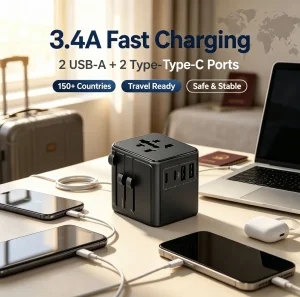
Furthermore, international enterprises operating within Bogotá's financial centers (such as the Centro Empresarial Santa Bárbara and Calle 72 corridor) continuously host corporate executives, expatriates, and trade delegates carrying high-draw modern hardware—including 65W–140W USB-C PD laptops, medical testing devices, broadcast gear, and high-wattage personal care items. Standard legacy converters frequently suffer catastrophic dielectric breakdown or severe thermal accumulation under sustained inductive loads, prompting commercial procurement departments to seek industrial-grade universal travel adapters engineered to modern safety thresholds.
Strict Compliance with RETIE Mandates
Colombia enforces the Reglamento Técnico de Instalaciones Especiales (RETIE), administered by the Ministry of Mines and Energy. Importers and commercial distributors must guarantee that electrical accessories adhere to stringent anti-tracking properties, flame-retardant housing criteria (UL94-V0 flammability ratings), and mechanical pin withdrawal tolerances to avoid immediate impoundment by the Dirección de Impuestos y Aduanas Nacionales (DIAN).
Subtropical Grid Volatility & Surge Suppression
Due to regional meteorological patterns and complex distribution networks across the Andean and Caribbean terrains, sudden transient voltage spikes and low-voltage sags are frequent. Factory-direct engineering incorporating Metal Oxide Varistors (MOVs) and high-rupture ceramic thermal fuses is non-negotiable for enterprise deployments protecting multi-thousand-dollar tech assets.
Why Chinese OEM/ODM Manufacturing Dominates the Supply Chain
Supplying the Colombian market requires a delicate balance of razor-sharp unit economics, rapid tooling iteration, and verifiable engineering compliance. While domestic Colombian assembly is largely constrained to basic building wiring and plastic conduit extrusions, our manufacturing ecosystem in Jiangmen, Guangdong brings over 30 years of vertical integration to global B2B procurement partners:
- In-House Tooling and High-Pressure Injection: Complete mold design control allows the integration of reinforced sliding mechanical shutters that prevent foreign object insertion—surpassing IEC 60884-1 and Colombian RETIE mechanical security standards.
- Integrated Metallurgical Stamping: We utilize specialized phosphor bronze alloys (QSn6.5-0.1) characterized by high elasticity and low resistance. Unlike cheap brass substitutes that lose clamping force after 300 cycles, our terminal contacts maintain steady contact pressure over 10,000 insertion cycles, preventing arc heating at 110V/10A high currents.
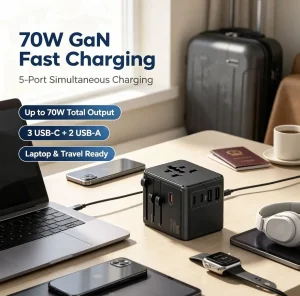
- GaN Semiconductor Circuit Optimization: Gallium Nitride III architecture minimizes thermal output in dense multi-port adapters. This enables 70W to 100W PD outputs inside compact form factors suitable for executive business travel across Bogota's high-altitude environments where heat dissipation dynamics shift.