
Featured USB & Type-C Power Distribution Units
Precision-engineered extension strips, universal travel adapters, and high-load commercial socket banks verified by international compliance testing laboratories.

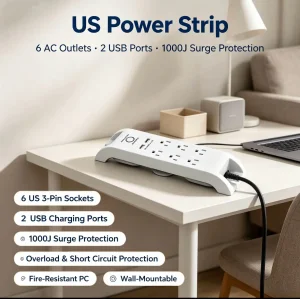
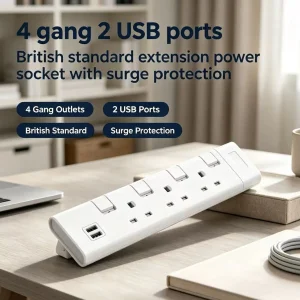
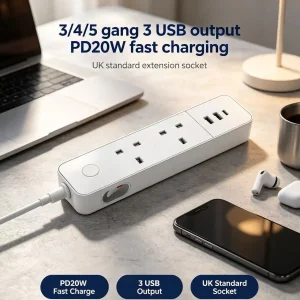
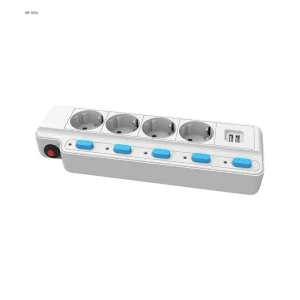
State of Global USB-C Extension Socket Architecture
The convergence of mains AC power distribution and high-density DC charging protocols represents a fundamental shift in commercial power design, transitioning traditional multi-gang taps into active power nodes.
GaN Power Semiconductor Integration
Conventional silicon MOSFET switches suffer from thermal dissipation barriers within confined power strip enclosures. Next-generation factories deploy Gallium Nitride (GaN III/IV) switching architectures, yielding 94%+ AC-to-DC conversion efficiency and allowing compact 65W to 140W USB-C PD modules to sit safely adjacent to high-load AC phosphor bronze busbars without exceeding IEC 60884 thermal thresholds.
Multi-Stage Transient Suppression
Modern industrial and workstation installations require hybrid surge protection systems combining Metal Oxide Varistors (MOVs) with integrated thermal fuses and Gas Discharge Tubes (GDTs). This design achieves ultra-fast clamping response under 1 nanosecond and high Joule energy ratings (1050J to 4000J), isolating sensitive micro-controllers and USB PD negotiating ASICs from utility transients.
Mandated USB-C Interoperability
Driven by the European Union Common Charger Directive (EU 2022/2380) and global harmonization standards, enterprise buyers are rapidly phasing out proprietary DC adapters. Multi-gang extension sockets must now feature native USB Type-C EPR (Extended Power Range) ports capable of powering enterprise laptops directly via USB-PD 3.0/3.1, eliminating external wall warts.
Engineering Blueprint: Component Integration & Safety Topologies
A granular examination of internal mechanical design, conductive alloy selection, thermal potting, and galvanic isolation required for multi-protocol commercial units.
AC Mechanical System
- Conductive Alloy: Continuous integrated H62/H65 Phosphor Bronze busbars; zero solder joints on high-amp lines.
- Contact Elasticity: 10,000+ insertion/extraction cycles with insertion force maintained within 15N–50N.
- Housing Enclosure: High-impact Polycarbonate (PC) meeting UL 94 V-0 flame retardancy at 750°C glow-wire test.
- Safety Interlocks: 75N dual-action child safety shutters preventing single-pin foreign object insertion.
DC Power Conversion
- Switching Controller: Quasi-Resonant (QR) Flyback or LLC Resonant converter with integrated GaN FETs.
- Protocol Negotiation: Autonomous PD 3.0 / PPS / QC 4.0+ IC communicating dynamic 5V/9V/12V/15V/20V rails.
- Synchronous Rectification: Low-RDS(on) secondary-side MOSFETs minimizing thermal conversion losses.
- Standby Consumption: Energy Star Level VI compliant; zero-load parasitic draw below 0.075W.
Dielectric Isolation & Safety
- Isolation Barrier: Reinforce insulation > 3,750V AC dielectric withstand between AC mains and DC USB circuits.
- Thermal Potting: High-conductive epoxy/silicone potting compound encapsulation for DC module thermal dissipation.
- Overload Protection: Hydraulic-magnetic or bimetal circuit breakers with automatic trip-free manual reset.
- EMI Suppression: Class-B compliant common-mode chokes and X2 safety capacitors for clean line output.
| Parameter / Metric | Legacy Economy Power Strips | Industrial-Grade GaN PD Sockets (Heikki Benchmark) | Compliance Standard |
|---|---|---|---|
| Internal AC Conductor | Riveted brass clips with point-to-point copper wiring | One-piece integral phosphor bronze punched busbars | IEC 60884-1 / BS 1363-2 |
| USB Delivery Capacity | 5V / 2.1A–2.4A shared USB-A (Max 12W) | Up to 65W–140W USB-C PD 3.1 PPS dynamic allocation | USB-IF / IEC 62368-1 |
| Surge Suppression Clamping | Single unshielded MOV (<300 Joules) | 3-Line (L-N, L-PE, N-PE) MOV + Thermal Cutoff + GDT (1050J–4000J) | UL 1449 4th Ed / EN 61643-11 |
| Flame Retardancy | Standard ABS plastics (UL 94 HB or V-2) | High-Tg Virgin Polycarbonate + ABS blend (UL 94 V-0) | UL 94 / IEC 60695-2-11 |
| Thermal Operating Window | -5°C to +40°C with rapid thermal throttling | -20°C to +65°C supported by internal structural potting | Enterprise Continuous Duty |
Jurisdictional Certification & Localization Architecture
International trade mandates stringent adherence to national electrical codes. Our production lines manufacture market-specific form factors with verified compliance portfolios.
United Kingdom & GCC
Standards: BS 1363-2, SASO 2203/2815, G-Mark, MS 589, SS 145.
Key Mandates: Integrated 13A ceramic cartridge fuse, shuttered earth aperture, minimum creepage distances >3mm, and individual DP switches where required.
European Union (Schuko)
Standards: CEE 7/7 (Type E/F), CE-LVD (2014/35/EU), CE-EMC (2014/30/EU), RoHS, REACH.
Key Mandates: Dual grounding clips, 16A 250V rating, shuttered sockets, H05VV-F 3G1.5mm² pure copper cords, and ErP Directive low standby loss.
North America (NEMA)
Standards: UL 1363 (Relocatable Power Taps), UL 1449 (SPDs), UL 498, FCC Part 15 Class B.
Key Mandates: 125V 15A rating, heavy-duty 14AWG (SJT) conductors, resettable thermal circuit breaker, and 330V–500V Voltage Protection Rating (VPR).
Southeast Asia & LATAM
Standards: TISI 2432-2555 (Thailand), PS Mark / PNS 1486 (Philippines), KC (Korea), NOM (Mexico).
Key Mandates: Mandatory thermal trip switches, customized plug geometry, extended cord lengths (5m/8m/10m), and tropicalized humidity resistance.
Full-Cycle OEM & ODM Supply Chain Governance
Operating from our 30,000+ m² factory campus in Jiangmen, Guangdong, Heikki integrates raw materials compounding, precision tooling, SMT high-speed placement, and automated QA.
Precision Tooling & Mold Workshop
In-house CNC machining and EDM wire-cutting ensure mold dimensional tolerances within ±0.01mm. We engineer multi-cavity injection molds for non-rearing flame-retardant housings, rapid-cycling tooling modifications, and ergonomic aesthetic profiles customized with OEM corporate brand embossing.
Automated SMT & Assembly
High-precision pick-and-place lines populate USB-C PD power boards using lead-free solder paste, automated optical inspection (AOI), and in-circuit testing (ICT). Robotic punching lines secure phosphor bronze busbars without manual strain, eliminating loose tolerances and cold-solder risks.
In-House Reliability Testing Lab
Every lot undergoes 100% full-load electrical safety screening: 3,000V dielectric hi-pot testing, ground continuity under 0.1Ω, 4-hour dynamic burn-in testing under full rated load, drop impact resistance, glow-wire fire testing, and 48-hour salt-spray corrosion analysis.
Future Roadmap: The Evolution of Intelligent Power Strips
Forward-looking architectural trends defining enterprise power distribution from 2025 to 2030, covering GaN-on-SiC, Matter smart ecosystem protocols, and micro-grid telemetry.
USB PD 3.1 Extended Power Range (240W)
Transition from standard 20V/5A (100W) charging rails to 48V/5A (240W) USB-PD EPR infrastructure. This eliminates bulky brick power supplies for high-performance engineering workstations, professional audio-visual consoles, gaming laptops, and lightweight electric mobility equipment directly through the extension tap.
Matter-over-Thread Telemetry
Integration of low-power multi-protocol IoT microcontrollers supporting the unified Matter standard. Commercial facilities can monitor individual gang current draw, calculate localized carbon footprints via embedded real-time power metering ICs (accuracy <1%), and execute automated load-shedding during peak utility pricing periods.
Solid-State Circuit Protection (SSCP)
Replacement of traditional mechanical bi-metal thermal trip breakers with high-speed silicon/GaN solid-state circuit breakers. Solid-state interruption executes in under 5 microseconds—over 1,000 times faster than mechanical switches—completely eliminating electrical arcing and dramatically enhancing commercial life expectancy.
Global Distribution & Commercial Solutions
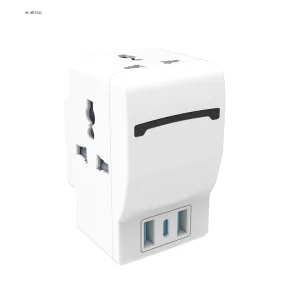
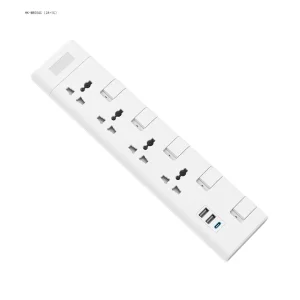
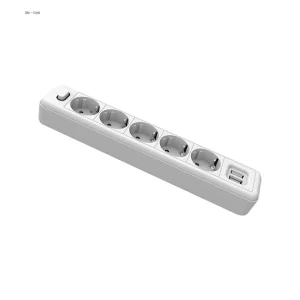
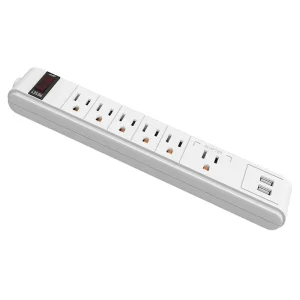
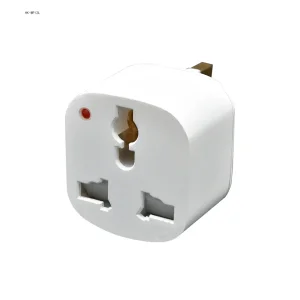
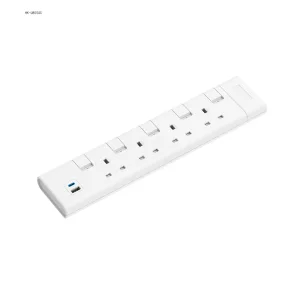
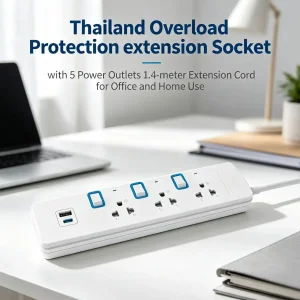
Explore additional certified extension boards, worldwide travel adapters, and heavy-duty power taps ready for container-load wholesale and custom brand labeling.
Technical Procurement & Engineering FAQ
In-depth answers to complex architectural, certification, and manufacturing inquiries faced by professional electrical importers and enterprise buyers.
Gallium Nitride features a bandgap three times wider than legacy silicon, translating to significantly lower electron resistance (RDS-on) and diminished switching energy losses. Because thermal loss is reduced by up to 60%, GaN-based power transformers and synchronous rectifiers generate significantly less waste heat. When combined with Heikki's thermal potting compound and internal isolated chamber layout, high-power 65W–100W USB-C DC modules operate safely under 65°C without passing thermal energy onto adjacent AC copper busbars.
Traditional low-cost power strips employ discrete brass spring clips connected with manually soldered copper wires. These solder points introduce high electrical contact resistance, are susceptible to cold-solder fracturing, and can overheat under 13A–16A loads. Continuous punched phosphor bronze (H65/QSn6.5-0.1) busbars provide seamless current distribution, reduce resistance across gang junctions, withstand 10,000+ mechanical insertions without elasticity degradation, and eliminate internal wiring harness failures.
Our products incorporate an autonomous protocol microcontroller that polls connected devices using CC (Configuration Channel) pins and D+/D- lines. When a single USB-C port is engaged, the IC opens the primary rail for full output (e.g., 65W PD). If a second USB-A or Type-C device is inserted, the IC momentarily renegotiates the handshake, automatically stepping the primary port to 45W and allocating 20W to the secondary port. This intelligent throttling prevents transformer saturation and eliminates nuisance tripping.
Under SASO 2203 and the GCC Low Voltage Technical Regulation (BD-142004-01), power strips require comprehensive type-testing through an accredited CB laboratory. Key compliance checks include BS 1363-2 dimensional verification, 13A rated loading with temperature-rise limits below 45K at terminals, shutter endurance under lateral force, 750°C glow-wire flammability on live-part insulation, and RoHS 2.0 chemical analysis. SASO also mandates an active factory inspection audit to secure the Saudi Quality Mark (SQM).
Type 3 SPDs according to EN 61643-11 / UL 1449 are designed for point-of-use equipment protection. Whereas service-entrance arresters (Type 1 and 2) absorb massive utility spikes, inductive switching surges and internal facility noise still propagate along branch lines. Our multi-stage transient suppression network deploys matched thermal-cutoff MOVs across Line-Neutral, Line-Earth, and Neutral-Earth, clamping residual voltage spikes below 1.2kV to safeguard microelectronics within laptops and network nodes.
Standard private-label programs (custom logo silkscreen/laser marking, color box packaging, tailored cord lengths) feature minimum order quantities (MOQ) starting at 1,000 to 2,000 units with typical lead times of 25–35 days. For full custom tooling (new housing industrial design, non-standard gang orientations, specialized internal PCB configurations), mold fabrication takes approximately 30–40 days, followed by pre-production sample validation within 10 days.